
3 Powerful Mudras to Transform Your Life: Apana Vayu, Kubera and Shankha Mudra
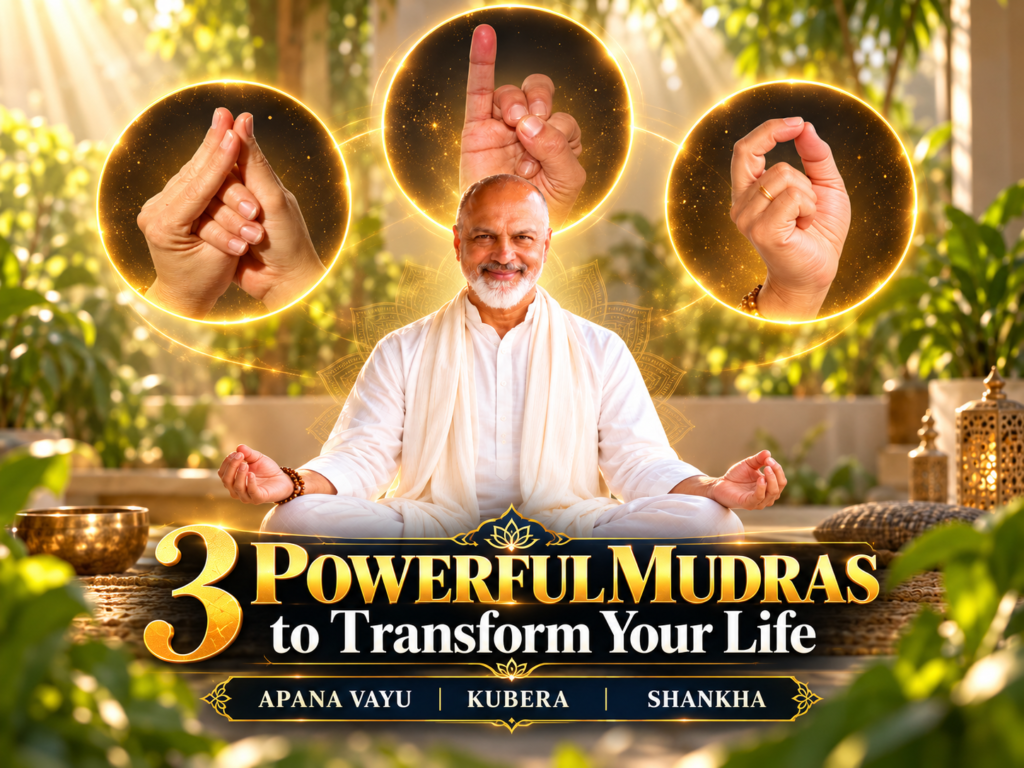
Mudras are a beautiful and powerful part of yogic science. These simple hand gestures can become a meaningful part of our daily spiritual practice, helping us cultivate awareness, focus, and a deeper connection with ourselves.
Each of these mudras has its own significance. From supporting digestion and elimination to cultivating a mindset of abundance and deepening our spiritual connection, they offer different ways to bring greater awareness into our lives.
In this blog, I want to share my three favourite mudras, how to practise them, and why I believe they deserve a place in your daily routine.
Apana Vayu Mudra: Supporting Digestion and Elimination
The first mudra I want to introduce is the Apana Vayu Mudra. It is one of my personal favourites, and I particularly appreciate its traditional association with elimination, detoxification, and digestive health.
How to Practise Apana Vayu Mudra
The Apana Vayu Mudra is relatively simple to perform:
- Sit comfortably in a relaxed position.
- Bend your index finger and bring its tip towards the base of your thumb.
- Touch the tips of your middle and ring fingers to the tip of your thumb.
- Keep your little finger extended.
- Rest your hands comfortably on your thighs and breathe naturally.
Once you have formed the mudra, close your eyes if you feel comfortable and bring your attention to your breathing.
You can begin with a few minutes of practice and gradually incorporate it into your daily routine.
Benefits of Apana Vayu Mudra
In traditional yogic practices, Apana Vayu Mudra is associated with the body’s processes of elimination and the downward movement of energy.
I find this mudra particularly interesting because it reminds us of the importance of allowing the body to release what it no longer needs.
However, while this mudra is traditionally associated with digestive and elimination benefits, there is limited scientific evidence that performing the hand gesture itself can detoxify the body or treat digestive conditions. It should be viewed as a complementary mindfulness practice rather than a substitute for medical care.
For me, the value of practising a mudra also lies in the awareness and intention we bring to it.
Kubera Mudra: A Mudra for Abundance and Prosperity
My second favourite is the Kubera Mudra, which is traditionally associated with wealth, prosperity, abundance, and the fulfilment of intentions.
When people hear about a mudra for making more money, they may immediately think of material wealth. But I believe abundance is about much more than money.
True abundance also means having happiness, good health, meaningful relationships, generosity, and the freedom to enjoy the life we are creating.
How to Practise Kubera Mudra
Here is how I practise the Kubera Mudra:
- Sit comfortably with your back straight.
- Bend your ring finger and little finger towards your palm.
- Bring the tips of your thumb, index finger, and middle finger together.
- Keep your hands relaxed and your breathing natural.
Once you are holding the mudra, allow yourself to settle into a meditative state.
I recommend practising it for around 10 minutes a day.
Visualising Abundance Through Kubera Mudra
There is something I particularly enjoy doing when practising this mudra: visualisation.
As you sit in the Kubera Mudra, imagine yourself surrounded by a beautiful golden aura. Visualise this golden energy coming towards you from all directions.
Feel a sense of abundance, gratitude, and possibility.
Rather than focusing only on the money you wish to attract, think about the experiences, opportunities, relationships, and happiness you want to welcome into your life.
For me, the deeper significance of this mudra lies in developing a mindset that recognises abundance while remaining open to giving and sharing.
It is important to understand that a mudra or visualisation cannot guarantee financial success. However, meditation can provide an opportunity to reflect on your intentions, develop clarity, and approach your goals with greater awareness.
Shankha Mudra: A Mudra for Spiritual Connection
The third mudra I want to share is the Shankha Mudra.

The Sanskrit word Shankha means conch. The shape formed by the hands resembles a conch shell, which has deep significance in Indian spiritual traditions.
This is a mudra I particularly value for its association with chanting, meditation, and the Vishuddha, or throat, chakra.
How to Practise Shankha Mudra
To form the Shankha Mudra, follow these steps:
- Extend your left thumb.
- Wrap the fingers of your right hand around your left thumb.
- Place the thumb of your right hand against the middle finger of your left hand.
- Extend the remaining fingers of your left hand upwards.
- Adjust your hands until they form a conch-like shape.
Hold the mudra comfortably in front of your chest, around the level of your Anahata, or heart, chakra.
Once you are settled, begin chanting Om gently.
I recommend practising for approximately 10 minutes, allowing the sound and vibration of the chant to become the focus of your attention.
The Connection Between Shankha Mudra and the Vishuddha Chakra
In yogic traditions, the Vishuddha Chakra is associated with the throat, communication, and self-expression.
Shankha Mudra is traditionally believed to support the activation or balancing of this chakra.
When I practise this mudra alongside chanting, I find that it creates an opportunity to turn my attention inward and become more conscious of my thoughts, words, and intentions.
As with other chakra practices, these associations belong to the traditional yogic understanding of the subtle body. They should not be confused with scientifically established effects on the physical throat or vocal system.
For me, the beauty of Shankha Mudra lies in combining a simple hand gesture with the power of sound, breath, and meditation.
How Regular Mudra Practice Becomes a Natural Part of Life
There is something fascinating that happens when you practise mudras consistently over a long period.
I have been practising mudras for years, and they have become such a natural part of my life that I sometimes find myself holding one without consciously thinking about it.
A few months ago, my wife and I were walking when she looked at my hand and pointed out that I was holding a mudra.
I had not even realised it.
I was naturally holding the Apana Vayu Mudra while walking.
My teacher, Guru Shabbat, shared a similar experience with me. He told me that sometimes he would wake up in the middle of the night and realise that he had been sleeping in a particular mudra.
These experiences have stayed with me because they reflect how deeply a regular practice can become integrated into our everyday lives.
When we repeat a practice consistently, it can become familiar and instinctive. We no longer need to consciously remind ourselves to do it every time.
This is one of the reasons I encourage people to explore mudras with patience and consistency.
Mudras, Energy, and Everyday Awareness
One of the ideas I often share when discussing mudras is the importance of becoming aware of how we carry ourselves throughout the day.
In yogic philosophy, the hands are considered important in the practice of directing and regulating prana, or life energy.
Mudras are traditionally understood as gestures that help channel this energy within the body.
When I walk with my hands open and relaxed, I am simply walking. But when I consciously bring my hands into a mudra, I create an opportunity to connect with my breath, my body, and my inner awareness.
The traditional yogic understanding is that mudras help retain and direct energy within the system.
From a practical perspective, holding a mudra can also serve as a reminder to pause, become present, and return our attention to ourselves.
Rather than moving through the day unconsciously, we can use these small moments to reconnect with our intentions.
I believe this is an important part of any spiritual practice: learning to bring awareness into the simplest activities of our lives.
While the idea that open hands cause energy to dissipate is a traditional spiritual interpretation rather than an established scientific fact, the practice of mindful movement and meditation can help us cultivate greater awareness of our bodies and mental states.
How to Incorporate These Three Mudras Into Your Daily Routine
You do not need to spend hours practising mudras to begin exploring them. Start with a few minutes each day and build a routine that feels comfortable.
Here is a simple practice you can follow:
| Mudra | Traditional association | Suggested practice |
|---|---|---|
| Apana Vayu Mudra | Elimination and digestive energy | 5–10 minutes |
| Kubera Mudra | Abundance, prosperity, and intention | 10 minutes |
| Shankha Mudra | Chanting, communication, and spiritual connection | 10 minutes |
Find a quiet place where you can sit comfortably without distractions.
Begin by taking a few slow, natural breaths. Practise each mudra gently, without straining your fingers or wrists. You can combine the practice with meditation, visualisation, or chanting, depending on the mudra.
Most importantly, be consistent.
If you have a medical condition or are experiencing persistent symptoms, do not rely on mudras as a replacement for professional medical advice or treatment.
Final Thoughts: Discover the Power of Mudras
There are so many mudras in yogic science, each with its own traditional significance and method of practice.
The three I have shared with you — Apana Vayu Mudra, Kubera Mudra, and Shankha Mudra — are among my personal favourites.
One is associated with elimination and digestive energy. Another invites us to reflect on abundance, prosperity, and generosity. The third brings together the symbolism of the conch, the practice of chanting, and the traditional understanding of the Vishuddha Chakra.
But beyond the individual mudras, there is one message I want you to take away.
Make your spiritual practice a part of your everyday life.
Do not think of meditation, yoga, or mudras as something you do only when you have extra time. Even a few minutes of conscious practice can become a valuable opportunity to pause, reconnect, and bring greater awareness into your day.
Explore these three mudras, practise them with patience, and discover how they fit into your own journey.
Because, ultimately, the beauty of any spiritual practice lies not just in knowing it, but in living it.
— Bijay J. Anand