
Veganism, Karma & Conscious Eating: What Does Food Have to Do With Our Energy?
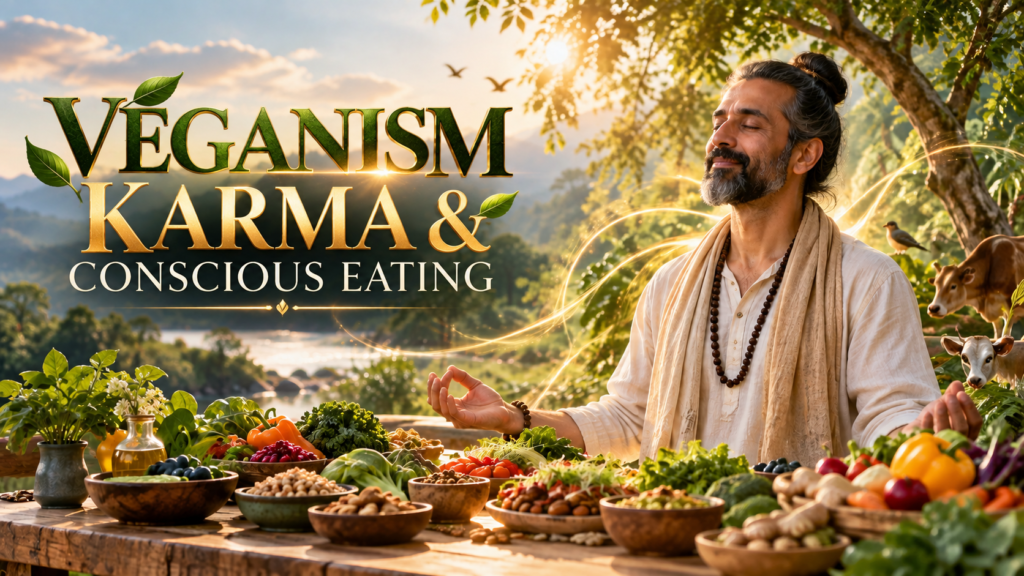
When we talk about food, we often talk about nutrition, taste, health and lifestyle. But there is another dimension to eating that is worth exploring: consciousness.
What happens to our energy when we eat certain foods? Does the way animals are treated before they become food matter? Can our food choices influence how sensitive we become to our own body and mind?
These are questions I have explored personally over many years.
And when someone asks me about veganism, my answer is quite simple: I am not a vegan myself, but I am in favour of veganism and would eventually love to become vegan.
My Personal Relationship With Food
Let me start by being completely honest. I love my tea with milk. I enjoy paneer, and occasionally I do eat non-vegetarian food.
At the same time, I would love to become a vegetarian, and eventually a vegan.
I have always believed that these changes should come from awareness rather than force. You don’t necessarily become vegetarian because someone tells you that you should. In my experience, you become vegetarian when your body itself begins to lose its desire for non-vegetarian food.
For me, conscious living is a journey.
It is about becoming more aware of what we consume, why we consume it and how it affects us.
Is Milk Really the Problem?
Traditionally, milk has been regarded in Indian culture as something deeply nourishing. I have often referred to milk as amrit because of the way it has historically been viewed in Ayurveda and traditional Indian thought.
But we also have to ask an important question:
What kind of milk are we consuming today?
There is a significant difference between traditional dairy practices, where cows were cared for, allowed to move freely and fed naturally, and intensive systems in which animals may be kept in confined conditions and managed primarily for higher production.
For me, this is where the question of animal welfare and karma becomes important.
If an animal is being treated cruelly, deprived of its natural environment or separated from its young for commercial production, I don’t believe we can completely ignore the ethical dimension of that process.
The issue isn’t simply whether milk is good or bad.
The deeper question is: What is the consciousness behind the way that food is produced?
Veganism, Animal Welfare and Karma
From a karmic perspective, I believe intention and action matter.
When an animal is subjected to suffering, fear or trauma, there is an energetic dimension to that experience that I believe deserves our attention.
This is particularly relevant when we talk about eating meat.
When an animal is killed, there is inevitably a physical and emotional process involved. From a spiritual perspective, I believe that the trauma associated with that process can influence the energetic quality of what we consume.
This is one of the reasons I increasingly feel drawn toward veganism.
For me, veganism is not simply about following a diet.
It can also be an expression of compassion, awareness and conscious living.
My Experience With Eating Meat
I have personally experienced something that made me think deeply about this.
Years ago, when I used to travel frequently, I would sometimes visit Michelin-starred restaurants and five-star hotels. At that time, ordering meat—particularly meat that was rare or medium-rare—was something I enjoyed.
There were occasions when the meat would still contain traces of blood.
What I noticed was unusual.
On the days when I ate meat that way, I would sometimes experience extremely disturbing nightmares at night.
This happened several times.
Eventually, around ten years ago, I decided to try it one last time—not because I wanted to continue eating that way, but because I wanted to see whether there was actually a connection.
I ate the meat and went to sleep.
Again, I experienced traumatic nightmares throughout the night.
Now, I understand that my personal experience cannot be used as scientific proof that eating meat causes nightmares. But for me, it became a powerful personal observation about how sensitive the body and mind can become.
Why Doesn’t Everyone React the Same Way?
Someone may naturally ask:
If eating certain foods affects me this way, why doesn’t everyone experience the same thing?
I think the answer is connected to sensitivity.
Imagine a body that is already overloaded with unhealthy food, stress and toxins. Adding something else may not produce an obvious reaction.
But when you begin cleaning up your lifestyle—when you meditate, eat consciously, practise yoga and become more aware of your body—you may notice things that you previously ignored.
Your body becomes more sensitive.
And I don’t see sensitivity as weakness.
I see it as awareness.
When the body reacts strongly to something, it may simply be telling us to pay attention.
Food, Energy and Consciousness
One of the most interesting things about conscious eating is that food is not only about calories or nutrients.
Our relationship with food also involves emotion, habit, culture, ethics and awareness.
What we eat can become part of our daily spiritual practice.
This doesn’t mean that everyone has to immediately become vegan.
I don’t believe in forcing people into a particular lifestyle.
Instead, I believe we should become more conscious of our choices.
Ask yourself:
Where did this food come from?
How was the animal treated?
What impact does this food have on my body?
How do I feel after eating it?
Does this choice align with the kind of person I want to become?
These questions can completely change our relationship with food.
Becoming More Conscious
For me, veganism represents an aspiration toward greater compassion and awareness.
I am still on that journey myself.
Also, I still drink tea with milk. And, I still enjoy paneer. But, I have not completely eliminated non-vegetarian food from my life.
But I am becoming more conscious of my choices. And perhaps that is the most important starting point. We don’t have to transform everything overnight. Sometimes the first step is simply becoming aware.
When awareness grows, our choices naturally begin to change. Ultimately, conscious eating is not about creating another set of rules.
It is about listening more deeply—to our body, our mind, our values and our connection with the world around us.
I would love to eventually become vegan, sooner rather than later. But more importantly, I believe we should all move toward greater consciousness in the way we eat, live and treat other beings.
Because the food we consume doesn’t exist in isolation.
It becomes part of us.
And when we become more conscious of what we put into our body, we may also become more conscious of the energy, intention and compassion with which we live our lives.
Satnam
-Bijay J. Anand