
What Is Prayer Really? Understanding the True Meaning of Prayer
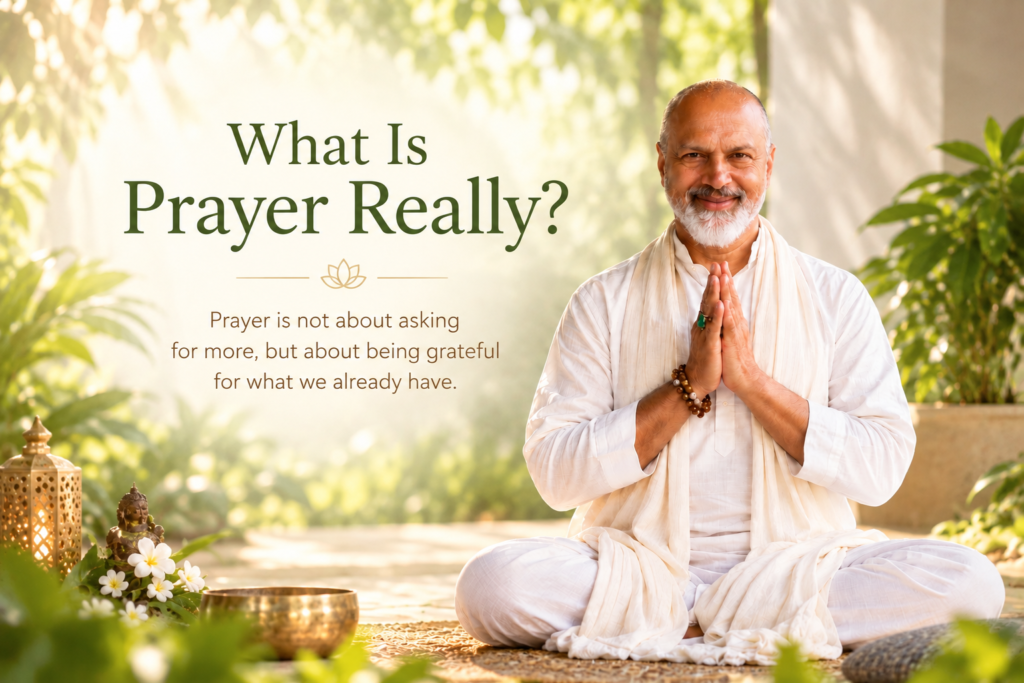
When someone asks me, “What is prayer?”, I believe the answer goes much deeper than simply folding our hands, visiting a place of worship, or asking for something we want.
For me, prayer is a way of connecting with a higher consciousness through the medium of the soul. It is a form of communication with something greater than our individual identity. I don’t necessarily mean God in the traditional sense. I mean the higher consciousness that surrounds us and connects all of existence.
Over the years, I have come to see prayer not as a transaction, but as an experience of connection, devotion, awareness and gratitude.
But before I explain what prayer means to me, I think it is important to understand what prayer is not.
What Is Not Prayer?
I often see prayer being treated as a transaction.
We go to a temple, church, mosque or gurudwara, stand before an idol or sacred symbol, fold our hands and start asking.
“I want a new house”
“I want a new car”
“I want a better job”
“I want a husband”
“I want a wife”
“I want this particular thing to happen in my life”
For me, that is not prayer.
You can call it whatever you want, but I don’t call it prayer.
I don’t believe the true meaning of prayer is about presenting a list of demands to the divine. Prayer, as I understand it, is much deeper. It is about devotion, surrender and recognising our connection with something greater than ourselves.
What is the connection between Prayer and Bhakti
For me, prayer is closely connected to Bhakti, or devotion.
Bhakti is not simply about performing rituals. It is about developing love, reverence and devotion toward something greater than ourselves.
When I experience Bhakti, I understand that I am a very small part of this incredibly vast and beautiful cosmos.
At the same time, there is another profound understanding expressed through Aham Brahmasmi—“I am Brahma.”
For me, these ideas help create a deeper understanding of prayer.
I may be a tiny part of this vast universe, but I am also connected to the consciousness that exists within and around me.
This is where prayer begins to move beyond ritual.
I am no longer approaching the divine as someone standing outside of existence and asking for things. I am recognising that I am already part of this existence.
What Does Aham Brahmasmi Mean in Prayer?
The concept of Aham Brahmasmi gives me another way to understand prayer.
It reminds me that there is a deeper consciousness beyond the limited identity I normally associate with myself.
My name, profession, possessions, relationships and achievements are all parts of my external identity. But they are not the entirety of who I am.
When I become aware of the deeper connection between myself and the universe, prayer becomes a form of communication with higher consciousness.
For me, prayer is that union.
It is the use of Bhakti, awareness and the understanding of Aham Brahmasmi to connect with the consciousness around me.
Prayer Is About Connection, Not Asking
When I pray, I am not trying to bargain with the universe.
I am trying to connect.
This distinction is important.
If I pray only because I want something, then my attention remains focused on what I don’t have.
But when I pray with awareness and gratitude, my attention shifts toward what already exists.
I begin to recognise life itself.
I recognise my body.
I recognise my breath.
I recognise nature.
I recognise the people and circumstances that allow me to experience this life.
For me, this is where the deeper meaning of prayer begins to reveal itself.
Prayer Is Gratitude
f I had to describe the essence of prayer in one word, I would choose gratitude.
I don’t believe prayer has to be about asking for more.
Prayer can simply be saying thank you.
When I fold my hands early in the morning, I don’t begin by asking Mother Nature for a bigger house, a better car or something else I desire.
I begin with gratitude.
I am grateful for the life I have been given.
I am grateful for this body.
I am grateful for my health.
I am grateful for the food that nourishes me.
I am grateful for the ground beneath my feet.
These things can seem ordinary because they are part of our everyday lives. But when I pause and become conscious of them, I realise how extraordinary they really are.
The ability to wake up, breathe, move, eat, walk and experience life is itself something worth being grateful for.
That, for me, is prayer
My Morning Prayer to Mother Nature
One of the ways I express this gratitude is through a simple morning practice.
When I wake up, I fold my hands and offer my gratitude to Mother Nature for the life I have been given.
I acknowledge my body.
I acknowledge the food that nourishes me.
I acknowledge the earth that supports me.
I then place three fingers on the ground and bring them to my forehead as a mark of respect and gratitude to Mother Nature.
For me, this simple gesture carries a deeper meaning.
It reminds me that I am not separate from nature.
The air I breathe, the water I drink, the food I eat, the soil beneath my feet and the sunlight that sustains life are all part of something much larger than my individual existence.
When I become conscious of that relationship, an ordinary morning can become an act of prayer.
What Is the Difference Between Asking and Prayer?
I want to make one distinction very clear.
There is nothing wrong with having desires.
I have desires. You have desires. We all want things in life.
But I believe there is a difference between asking for something and experiencing true prayer.
If I go to a temple and spend my time begging for a bigger house, a better car, a husband or a wife, I don’t call that prayer.
That is asking.
For me, prayer is something different.
Prayer is gratitude.
Prayer is awareness.
Prayer is devotion.
Prayer is recognising that I am part of something infinitely larger than myself.
Prayer is connecting my individual consciousness with the higher consciousness around me.
How Can I Practice Prayer Every Day?
I don’t believe prayer needs to be complicated.
It doesn’t necessarily require an elaborate ritual or a specific place.
I can pray when I wake up in the morning.
I can pray while sitting quietly.
I can pray when I look at nature.
I can pray when I become conscious of my breath.
I can pray simply by pausing and acknowledging the extraordinary fact that I am alive.
For me, prayer is not about what I can get from existence. It is about recognising what existence has already given me.
When I understand prayer in this way, it stops being a request and becomes a relationship—with consciousness, with nature, with existence and ultimately with myself.
That, to me, is what prayer really is.
Satnam
– Bijay J Anand