
In the hyper-quantified world of contemporary wellness, we often view water through a purely biochemical lens. We measure our daily intake in ounces, tracking every glass through smartphone apps and smart water bottles. We treat water as a sterile liquid, a mechanical coolant to lubricate joints, carry nutrients, and wash out the kidneys.

But thousands of years before the advent of nutritional science, the ancient Ayurvedic seers (Rishis) had a radically different perspective. Water (jala) is not a chemical compound (H₂O) in Ayurveda. It is revered as one of the Pancha Mahabhutas (Five Great Cosmic Elements) and celebrated as a sacred, living vessel of Prana—the very core life force of the universe.
Water, consumed without thought, can be a silent poison, extinguishing the metabolic fire and sowing chronic dysfunction. But in the classical protocols of Ayurveda, water transforms into Amrita, the divine nectar of rejuvenation, spiritual alignment, and long-lasting vitality.
The Chemistry of Thermal Energy: Why Ice water kills Agni
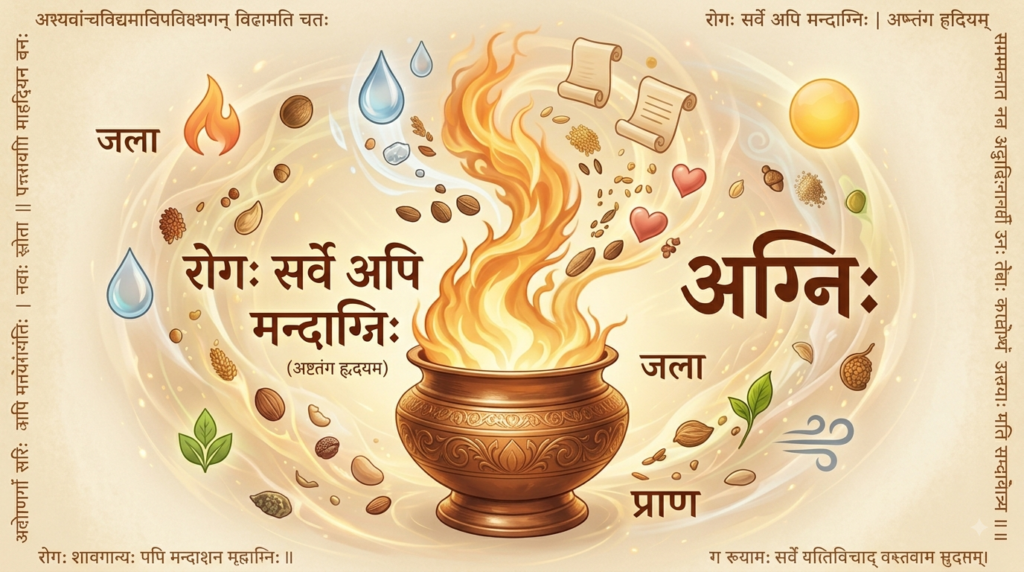
In traditional Ayurvedic diagnosis, the basis of good health is Agni, the primary metabolic fire that digests thoughts, feelings, and physical food. Roga Sarve Api Mandagni (all physical and mental diseases are due to diminished digestive fire) is the basic principle stated in the classical text Ashtanga Hridayam.
Downing iced drinks or cold water puts your internal systems into thermal shock. The stomach lining is immediately constricted by cold water, extinguishing the metabolic fires required for breakdown and nutrient absorption.
“Ice-cold water leads to acute stagnation of the digestive tract, aggravates Kapha and Vata doshas, and converts healthy chyme into undigested, toxic sludge (Ama).”
– Ashtanga Hridayam, Sutrasthana (Chapter 5)
The Medical Power of Ushnodaka (Warm Water)
To aid Agni, Ayurveda recommends Ushnodaka, water that is heated and served warm. Boiling changes the physical characteristics of water, making it lighter (Laghu) and able to traverse the fine cellular pathways (Srotas) to eliminate entrenched metabolic waste.
- Warm water that has just been boiled: Stimulates Agni, assists in breaking down dense fats, and eliminates mucus from the respiratory and digestive systems.
- Water that has been boiled and then cooled to room temperature loses its dense quality and gains a cooling property, rendering it the perfect remedy for offsetting excess heat and inflammation (Pitta dosha)
Posture and Consciousness: The Sacred Protocol of Hydration.
Contemporary living practices promote hydrating on the go, swiftly consuming water while hurrying to appointments, lingering in kitchens, or operating vehicles. Ayurveda cautions that eating quickly activates a protective stress reaction in the automatic nervous system.
While standing or walking, your body stays in an elevated state of sympathetic activation (“fight or flight”). Consuming water in these circumstances drives liquids through the digestive system at an abnormally quick rate, skipping adequate blending with salivary enzymes and placing undue strain on the kidneys’ fluid-filtering processes.
The Practice of Seated Hydration
Ayurvedic teachings recommend a specific practice: Always sit down, sip slowly, and take breaks between each swallow.
Taking a seat alters your physiology to a parasympathetic condition (“rest and digest”).
This allows the esophageal sphincter to loosen, permitting fluid to pass easily into the stomach, where it mixes with gastric fluids. Sipping gradually allows water to blend completely with alkaline saliva, adjusting gastric acidity before it reachs the bloodstream.
Precise Timing: The golden windows of drinking water
A crucial understanding in Ayurvedic gastroenterology is the connection between fluid intake and meal schedule. Consuming substantial amounts of liquid immediately before or after eating weakens gastric juice, impairing digestive effectiveness.
| Timing Window | Impact on Digestive Physiology | Classical Source |
| 30 Minutes Before Meals (Pratham) | Extinguishes Agni, dilutes digestive juices, and leads to chronic weakness or emaciation (Karshya). | Sushruta Samhita, Sutrasthana |
| Sipping During Meals (Madhya) | Functions as amrita; lubricates dry food, assists enzymatic action, and optimizes nutrient absorption. | Ashtanga Hridayam |
| Directly After Meals (Ante) | Smothers digestive fire, encourages sluggish intestinal transit, increases Kapha, and causes weight gain (Sthoulya). | Charaka Samhita |
The golden rule: Consider meals as a campfire. Refrain from consuming large amounts of liquid 30 minutes prior to meals, and hold off for 45 to 60 minutes after eating before drinking a full glass of warm water. While eating, consume only small, mindful sips of warm water or herbal tea to help digest dry, heavy food.
Tamra Jal: The Alchemical Power of Copper-Infused Water
Long before contemporary microbiology revealed copper’s wide-ranging antimicrobial abilities, Ayurvedic practitioners employed copper containers to cleanse and energize drinking water—a method called Tamra Jal.
When water remains in a pure copper container for 8 to 12 hours, small quantities of ionic copper seep into the water. This delicate leaching effect eliminates dangerous pathogens and changes the water’s molecular structure through what contemporary physics refers to as the oligodynamic effect.
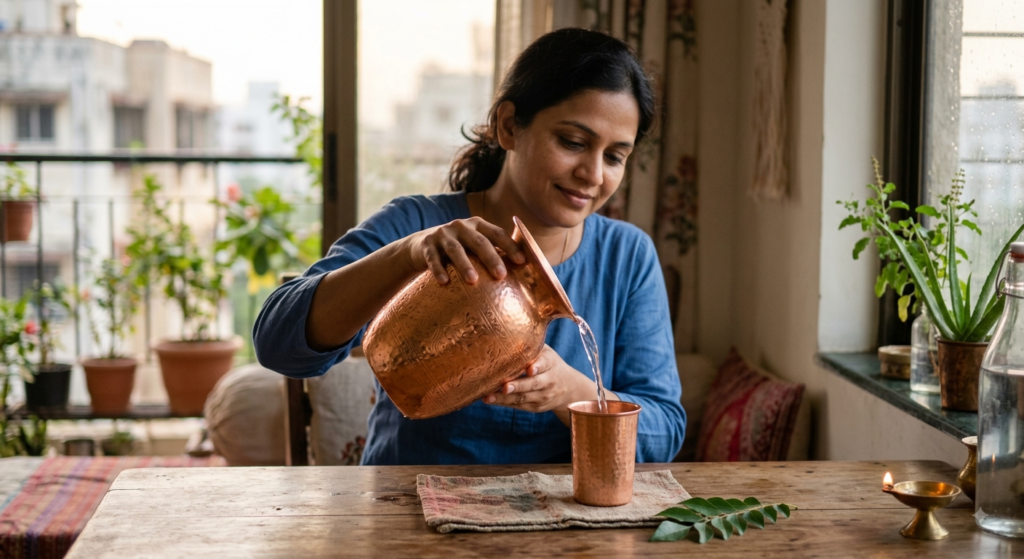
“Water stored in a clean copper vessel overnight harmonizes all three doshas (Vata, Pitta, and Kapha), purifies the vascular channels, and stimulates hepatic function.”
Your everyday guide to Ayurvedic hydration
- Skip the ice: Opt for warm or room-temperature drinks to safeguard your digestive fire (Agni).
- Relax to Drink: Take a seat comfortably and take slow sips rather than gulping while on your feet.
- Time your eating: Refrain from drinking 30 minutes prior to eating and hold off for 45-60 minutes post-meals before consuming large beverages.
- Consume water stored in copper (Tamra Jal) first thing in the morning to promote natural detoxification.
- Drink with Awareness: Take a moment to express gratitude before hydration, tuning into the vital essence of water.