
Prayer is one of the oldest and most universal spiritual practices. But what is prayer really? Is prayer simply asking for what we want, or can it be something deeper?
According to the perspective shared by spiritual teacher Bijay J. Anand, true prayer is not primarily about asking for possessions, circumstances, or personal outcomes. It is about connecting with higher consciousness through the soul. As its heart, prayer can be understood as a movement from desire to gratitude and from the individual self toward deeper connection.
What is prayer ?
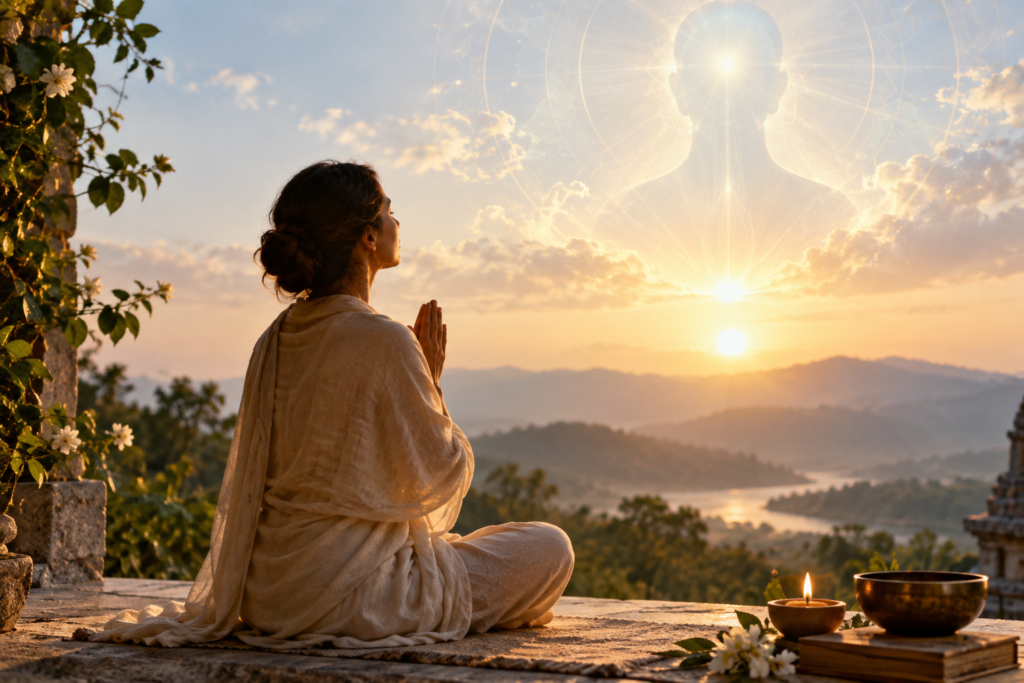
Prayer can be understood as calling out to a higher consciousness. This does not necessarily have to mean defining that consciousness as God. Instead, prayer can be inner communication with something greater than the individual self.
When a person still, turns inward, and communicates through the soul, prayer becomes more than words. It becomes a conscious attempt to connect with higher consciousness.
Rather than treating prayer as a transaction, it allows prayer to become a practice of connection and awareness.
What is not a Prayer ?
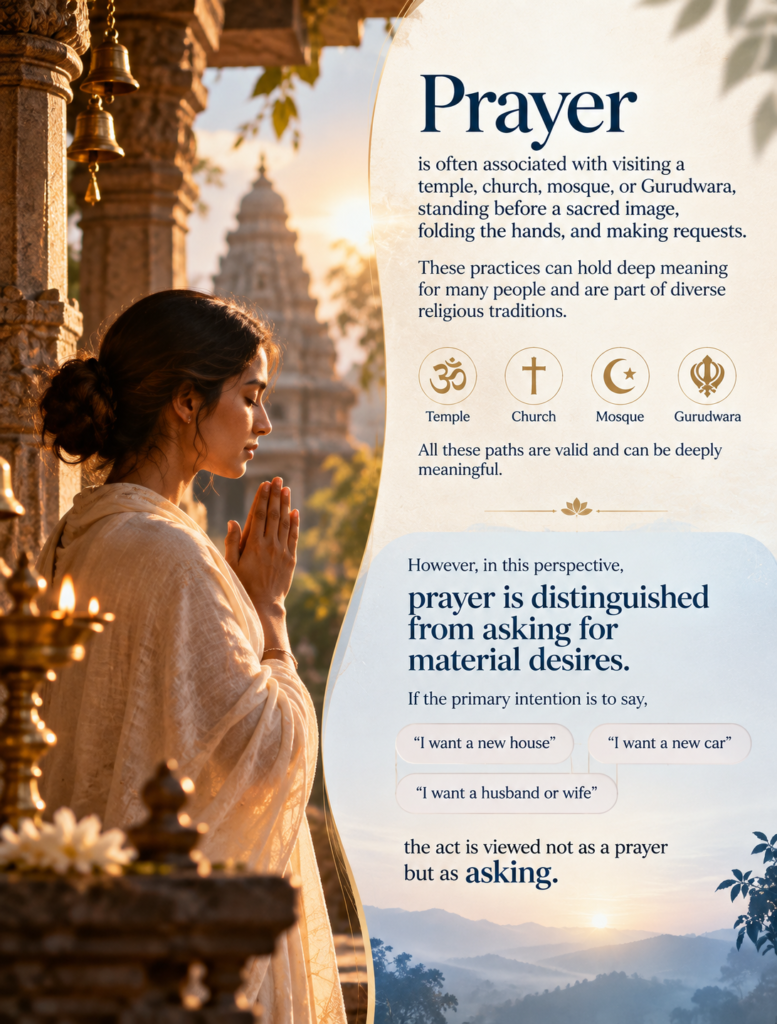
Prayer is often associated with visiting a temple, church, mosque, or Gurudwara, standing before a scared image, folding the hands, and making requests. These practices can hold deep meaning for many people and are part of diverse religious traditions. However, in this particular perspective, prayer is distinguished from asking for material desires.
If the primary intention is to say, ” I want a new house”, “I want a new car”, or “I want a husband or wife”, the act is viewed not as a prayer but as asking.
Wanting something is natural. Making a request is also a familiar part of religious practice. But true prayer, in this spiritual understanding, begins when the focus moves away from personal demands and toward devotion, awareness, and gratitude.
Bhakti and the understanding of Aham Brahmasmi
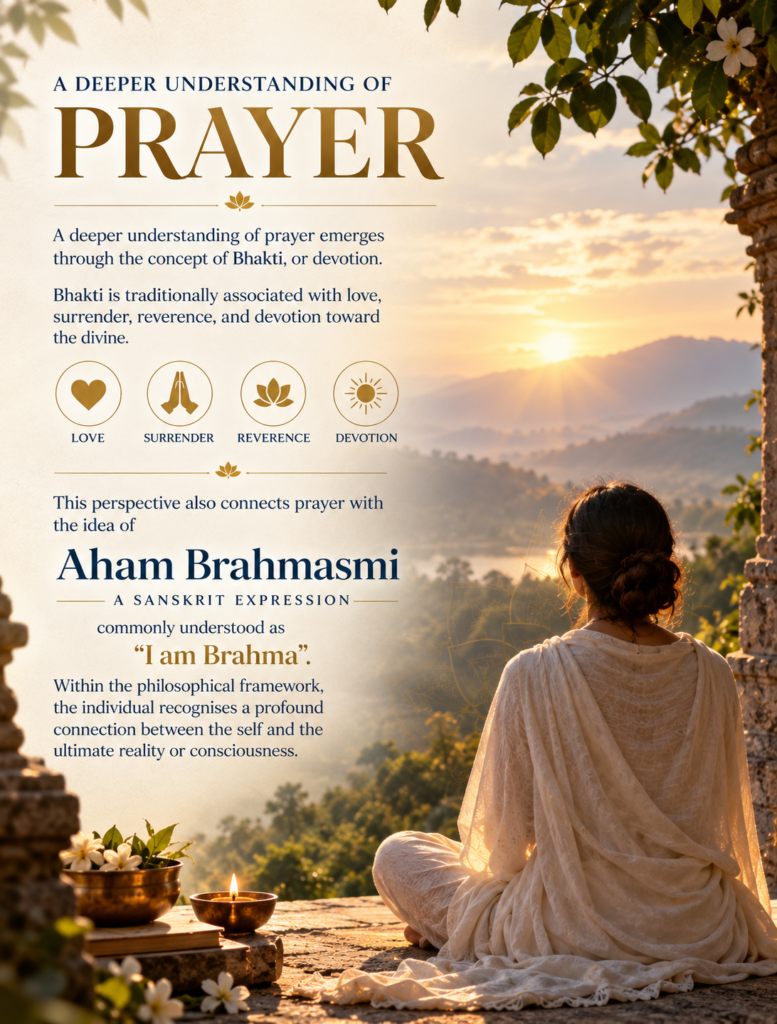
A deeper understanding of prayer emerges through the concept of Bhakti, or devotion. Bhakti is traditionally associated with love, surrender, reverence, and devotion toward the divine.
This perspective also connects prayer with the idea of “Aham Brahmasmi”, a Sanskrit expression commonly understood as ” I am brahma”. Within the philosophical framework, the individual recognises a profound connection between the self and the ultimate reality or consciousness.
The individual is a tiny part of an infinitely vast and beautiful cosmos, while also carrying within the self a connection to that greater reality.
Prayer, therefore, becomes an experience of union: using devotion and this deeper understanding of consciousness to connect with the world around us.
Connecting with higher consciousness
Prayer can become a quiet moment of communication with higher consciousness. It does not necessarily require elaborate rituals, long prayers, or specific surroundings. The essential element is the quality of awareness behind the practice.
When we pause and turn inward, we create space to listen rather than constantly demand. We become more aware of life, nature, our bodies, our relationships, and the consciousness that surrounds us.
This can make prayer a deeply personal spiritual practice. The words may differ, but the intention can remain the same: to connect, recognise, respect, and become aware with greater awareness and humility each day.
Prayer as Gratitude
One of the most powerful ideas in this understanding of prayer is that true prayer does not ask for anything.
Instead, prayer becomes gratitude.
Imagine waking up in the morning and folding your hands, not to ask for bigger house, a better car, more money, or a particular outcome, but simply to say thank you.
Grateful for existence, vitality, nourishment, and the earth that carries us.
This simple shift can transform the experience of prayer. Instead of focusing on what is missing, attention moves toward what is already present.
Gratitude towards Mother Nature
A morning prayer of gratitude can also become a way of acknowledging Mother Nature. Every day, we depend on natural systems for air, water, food, soil, sunlight, and the conditions that allow life to exist.
In the practice described by Anand, placing three fingers on the ground and the bringing them to the forehead becomes a gesture of respect toward Mother Nature. The movement symbolises gratitude for the earth beneath us and recognition of the life it supports.
Such a practice does not need to be complicated. Its meaning comes from awareness. The physical gesture becomes a reminder that life is interconnected and that we are recipients of countless things we did not create ourselves.
Asking vs True Prayer
There is a clear difference between asking and gratitude. Asking focuses on obtaining something. Gratitude focuses on recognising what already exists.
This does not mean that human desires are wrong. People naturally have goals, needs, hopes, and dreams. The distinction is about what we choose to call prayer.
From this perspective, repeatedly asking for a bigger house, a better car, a spouse, or another personal desires simply asking. Prayer begins when there is no demand attached to the act.
The essence of true prayer
So, what is prayer really?
Prayer can be understood as a sacred pause-a moment when the individual turns inward, connects with higher consciousness, and recognises that beauty of existence. It is Bhakti, awareness, connection, and gratitude.
True prayer does not have to be about getting something. It can be about realising how much has already been given.
The next time you close your eyes, fold your hands, or simply sit quietly, consider changing the question. Instead of asking,”What can I receive?” ask yourself, ” What can I be grateful for?”
Perhaps that simple shift is where prayer truly begins.